

Equinox Resolution Practice
Supporting Conflict Resolution through Integrated Services
How can you tell if the truce isn’t really holding?
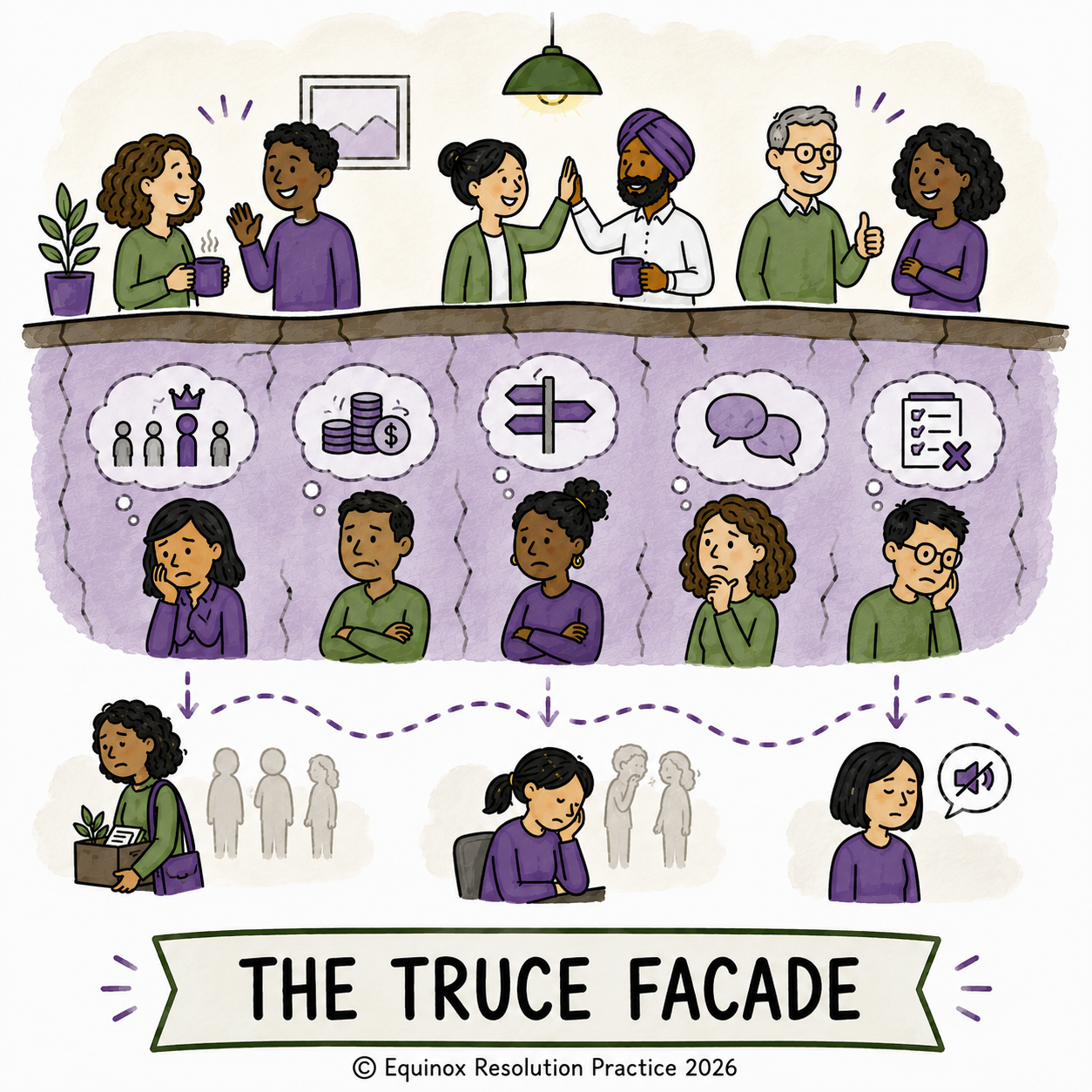
Informality can feel like a strength: friendly owners, an easy rapport, no red tape getting in anyone's way. Then a disagreement about scheduling turns into a litany of complaints: favouritism, pay scale, no clear management direction. Quieting the argument doesn't make it go away. It just relocates, still shaping who stays, who leaves, and who's stopped speaking up. These are just a few iterations of workplace conflict.
This shows up most visibly in smaller organizations, where informality substitutes for structure, but the same pattern plays out anywhere structure hasn't kept pace with growth: a hospital department, a government office, a fast-scaling team. That's one aspect of The Truce Facade: a version of peace built from policies nobody follows and a truce nobody actually agreed to. It looks like resolution. It's really just gone underground.
Equinox Resolution Practice (ERP) is a conflict consulting, coaching, and mediation partnership built to address what's actually underneath the facade, for non-profits, healthcare, education, government, and tech organizations up to 500 employees whose conflict has outgrown what internal resources can resolve.
What Changes?

Organizations that work with us don't just resolve the immediate conflict. They leave with leaders who can hold complexity and difficulty, teams that are genuinely more cohesive and solutions-focused, and the organizational capacity to de-escalate before things escalate.
Why It’s Different
Conflict isn’t something that just arises… it’s also something that doesn’t go away.

It's part of a larger system — often a legacy one — where challenges have compounded over time: maybe misaligned values, culture, and operations; or a lack of skilled conflict leadership; even outdated onboarding, training, and engagement policies.
Left unaddressed, these challenges don't just disrupt process and productivity but may create job-related mental stress injury or trauma that could leave the organization open to WSIB or ESA complaints and actions.
That’s why it’s important to understand the many faces of The Truce Facade.
-
We don't diagnose one problem. We look at the whole environment your conflict is living in, and build an integrated solution across four areas that reinforce each other:
Education: Understanding what's happening before it escalates, through training on the topics that matter most to your organization.
Systems Analysis: Examining the structures, policies, and legacy patterns that create conflict.
Leadership & Team Coaching: Supporting the people who carry responsibility for culture, one-to-one or in groups.
Qualified Mediation: Formal, Q.Med-credentialed mediation where it's needed, so outcomes actually hold.

How We Work Together

Over 3 months, your organization will fundamentally shift how it views, engages with, and supports conflict resolution. You'll build more clear and effective policies and procedures that your teams at all levels actually get trained to use — sometimes even identifying challenges before they become polarized conflict.
-
Your culture will start to treat conflict as an expected, even useful, part of creative and collaborative work instead of something to avoid. That shift ripples outward: better hiring, stronger trust, a more re-energized organization overall.
A typical engagement begins with a discovery discussion with Ayesha and Shannon, followed by an environmental and systems diagnostic using our proprietary SWORDS Assessment. We create a safe container for honest input at every level of your organization. This may include organization-wide surveys, one-on-one conversations across leadership and staff, and a review of policies and procedures; anywhere The Truce Facade may be in play.
Then we provide a full service plan for your review, and move forward on a timeline we agree on together.
Who is it for?

Non-profits, healthcare, education, government, and tech organizations from small businesses up to 500 employees dealing with chronic or acute conflict that talk-to-your-manager policies can't resolve.
Reach out today for a confidential conversation about your organization’s challenges and needs. We’d be happy to explore whether we’re the right fit to support you.